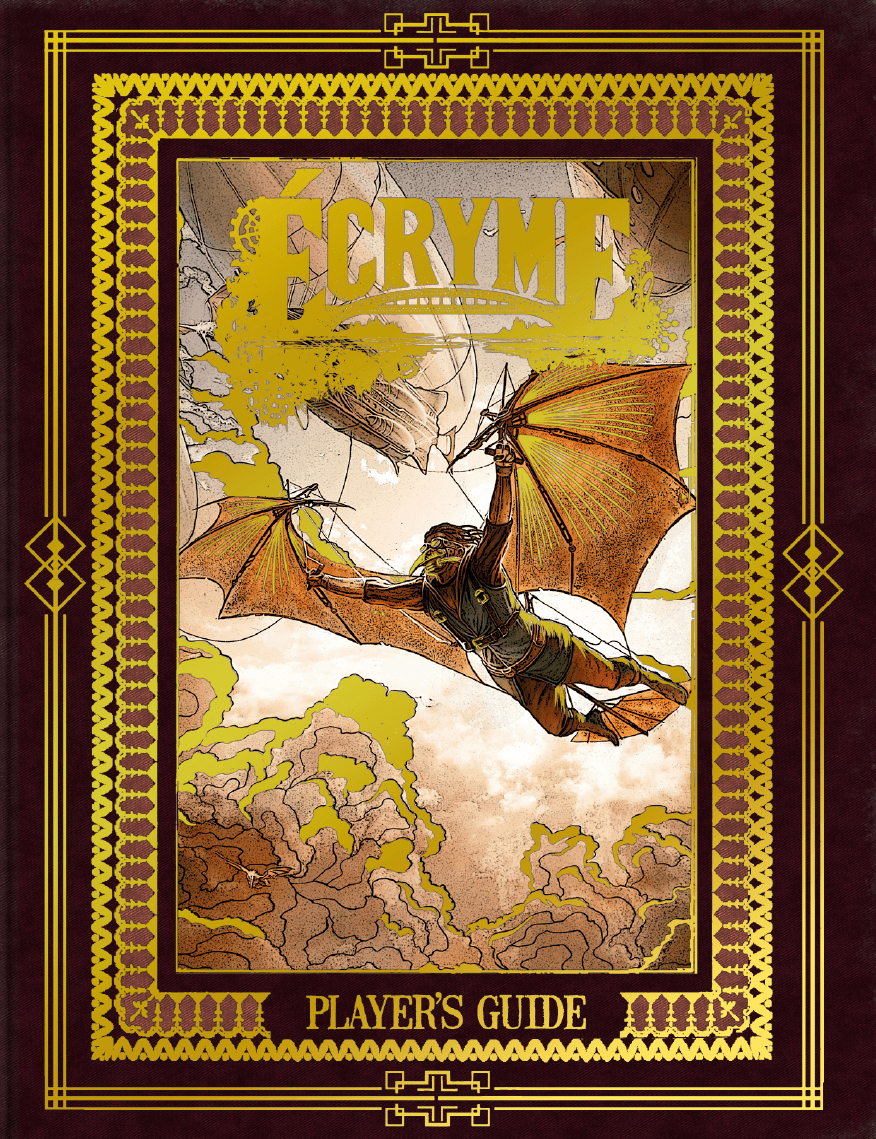
Ecryme starts off with a whole “what is game” section that under normal circumstances I would skip and generally don’t think is necessary in a new RPG book; at most, a simple If you don’t know what a tabletop RPG is, just Google it will suffice as I think this is a) often used to pad out a book and b) either doesn’t really say anything or is contradictory to the actual rules. I will save this for a blog post, but I feel like headdesking very time I read, An RPG is a collaborative story-telling game.
I am pleased to say that Ecryme does something quite different! The book starts off with seven pages of general TTRPG philosophy and best practices. I really appreciate the overall effort here in the attempt to be complete in answering the question, What Is A Role-Playing Game; and this is also a precursor of what is to come: Ecryme is a game that takes its time contextualizing each part in a way gives a very thorough consideration before moving on. This is borne out by the fact that the game system rules don’t appear until one hundred and eighty-plus pages into the book!
The section What Is a Role-Playing Game is divided into the following sections:
What Does Playing the Game Look Like?
Basic Principles
The Importance of the Rules
Advice for Players
Advice for Storytellers*
* Another niggling issue with the book is that the front matter refers to the GM as Storyteller but the rest of the book refers to the GM as Conductor. I have brought this to the editor’s attention and hopefully it will be corrected in the final product.
The introductory paragraph tells us that “a role-playing game is a one-of-a-kind activity in which an interactive oral story is created by a group.” This is standard boiler plate what is game stuff; the real interesting bits are coming up after and I would say the section is well worth the read even for veteran players.
There is a small hint here as to the game system which I didn’t notice on my first read-through, “all you need is this rulebook, some pencils, paper, and some six-sided dice (also known as d6s…).”
WHAT DOES PLAYING THE GAME LOOK LIKE?
This section has a nice breakdown on narrative voice and it hews closely to my personal philosophy that referring to your character in first or third person is irrelevant — it’s all roleplaying!
This holds true for both players and GMs and I know that I personally switch from portraying an NPC’s voice to the GM/Narrator’s voice as often as is necessary within a scene.
BASIC PRINCIPLES
This section talks about the Social Contract and safety tools. Everyone is at the table to have fun, we should all be respectful of others, players should try to actively engage with the fiction but also should have a safe space to veto anything they find objectionable. Players should also respect others’ level of immersion and their choice of narrative voice.
Under Briefing And Debriefing Sessions, it talks about ways to use session recaps to keep everyone focused on the main plot points. It also talks about leaving themes open for player input and veto’ing. I’m okay with this in principle, but really think this is why you have a Session Zero: once the group agrees on the tone of the game it’s then part of the social contract and I find it unnecessary to ask this after every session; checking the pulse of your group periodically is very important, though, especially over a lengthy campaign. So whilst I understand why this is here, I wish the other side of the argument (the Social Contract and Session Zero) was also placed into this section.
GAMEPLAY EXAMPLE
The example of play in the Basic Principles section is the closest we get to what the game mechanics entail for many hundreds of pages, so let’s see what we can divine from this sidebar. The GM tells a player to make a Guile test against a Difficulty of 10. The player then rolls 2d6 and announces that his total is 12 and thus a success.
So possibly a mix of skill/attribute plus dice vs a target number mixed with PbtA style approach?
THE IMPORTANCE OF THE RULES
I really like how Ecryme takes the time to say that rules are important and necessary for fair play. This section even states The universe itself is a subset of rules. YES! Rules = Setting and Setting = Rules! 100% agree here.
In the subsection Spirit of the law trumps letter of the law, the reader is introduced to the concept of rulings over rules, something I personally am a strong believer in, especially when it would slow down play to look up a rule. Make a ruling, get on with the game, and address it offline if necessary. I am sure there will be blog posts on how to adjudicate rulings in the future.
ADVICE FOR PLAYERS
There’s some stellar advice in this section, too! I particularly like the subsection Don’t Be a Prisoner to Your Character’s Backstory. Now, in some games (7th Sea 2e comes to mind), the players are very much trying to complete a story arc, but even in that game your background is what your character was before becoming a Hero. The same holds true here — play to find out. There are some pointers in how you can achieve this. I particularly like the tip of not having your character’s backstory end just before the start of play; allow some time to pass to allow your character some flexibility and room for improvisation.
The rest of the section covers a lot of helpful tips as well that could apply to any other collaborative game: embrace other opinions; know when to make concessions for the good of the group; when a group decision is made, even if you disagree, support it; respect the GM’s rulings, etc.
ADVICE FOR STORYTELLERS [GMs]
LOTS of useful advice for new or intermediate GMs! This section covers the importance of listening to the players, being fair, and not falling into the trap of prescripting the outcome of a scene. Set the scene but leave room for imagination, the book advises. I agree.
I really like the advice in painting a scene with as few brushstrokes as possible and letting the players’ imaginations fill in the detail:
“If the storyteller speaks of an attractive person, players will imagine someone who is good-looking according to their own subjective criteria for beauty. There is not necessarily any need to be more precise than that.”
This section really was a pleasant surprise and goes far beyond what most RPG rulebooks will state under the “what is game” section of the rules. Quite honestly, this section could be broken out and presented as a stand-alone treatise on good role-playing practices in same the way that Principia Apocrypha is to old school D&D play.

 Math & Myth
Leave a comment