Part II of the Player’s Guide is entirely epistolary in nature, sourced from in-world documents detailing various aspects of life on the traverses, stitch estates, and cities. If any of this seems boring, I will admit … this takes some serious dedication to get through and to me still seems like it could be a rather high bar to clear for many players and GMs.
THE BIRTH OF A TOWN
This is a brief in-world document detailing how stiltwalkers explore the ecryme, building traverses to expand to unexplored or newly discovered islands.
LIFE ON A STITCH ESTATE
Another in-world document which provides some insight into the rules of Aragon, the pseudo-religious methodology adopted to teach metallurgy. Stitch Estates are governed by feudal lords called Stitch Lords.
URBANISM ON THE TRAVERSES
The first weft’s traverses are embellished with beautiful stoneworks: decorative pillars and reliefs, though largely worn down by the acidic air and left to erode instead of being maintained.
Mining ores from the ecryme is a time-sensitive process which leads to rather barbaric conditions for those working the mine.
The hierarchy among the traverses is: cities, junctions, then relays, in descending order of importance. Junctions can be as large as cities, but are not connected to any sort of land mass. Relays are the smallest areas of grouped settlements on the traverses.
ENTERING A CITY
With population being strictly regulated in cities, those wandering the traverses may spend days waiting outside of a city’s gates before being allowed to enter. If a traveller does not have business within the city, they are assigned a job right on the spot and must report to work upon entering.
URBAN GEOGRAPHY
Urban Landscapes
Most buildings are taller than three stories, supported by metal structures, and are connected to one another by iron passageways. I really like the imagery here, of a city with multiple vertical layers and the wealthiest living the furthest from the ecryme and where there is the most available light; reminds me of a steampunk take on a cyberpunk setting.
Stilt Neighborhoods
On the outermost boundaries of the cities dwell its poorest denizens on dangerous platforms jutting out over the ecryme; collapse is a regular occurrence and life here is a desperate struggle for scraps.
Conditioned Development
Urbatechs are tasked with city planning to prevent city expansions from being utterly chaotic. To avoid power struggles, each city has specialized in a particular sector of urban development, be it aeronautics, electricity, or scientific inventions.
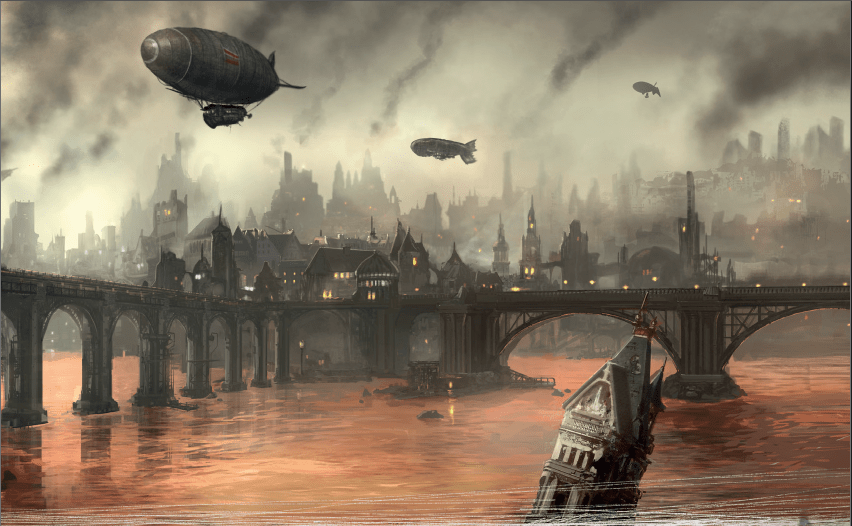
A CLOSER LOOK AT ARCHITECTURE
Standardized Dwellings
From the 9th century onward, building materials across the traverses standardized due to limited resources, with the wealthiest dwelling in stone strongholds and most people dwelling in homes of soot-gray brick, which are sometimes painted.
Finding One’s Way Around in the Cities
With the majority of the population being illiterate, landmarks are the generally accepted way of navigation, with iron signs being used only in the wealthiest of neighborhoods. Ecryme is a game that leans heavily into class distinction and there is a clear divide between the Haves and the Have-Nots.
From Darkness to Light
Every resource in Ecryme is a rarity and commoditized, and light is no exception. Between the high, tightly cramped buildings, iron walkways crisscrossing between them, constant rain, fog-shrouds, and columns of thick smoke, natural light is near-scarcity unless you are in a specially-designated area.
DIVISION OF THE SOCIAL CLASSES
Speaking of class distinctions …
The Differences Between Classes
The division of social classes is largely similar from city to city: upper classes live in neighborboods furthest from industrial areas whilst the workers live very close, and sometimes in, the very factories in which they work.
At the very top rungs of the social ladder, the bourgeois have their own neighborhoods in a vastly different lifestyle than the other 99% of the populace, with poor/lower class residential neighborhoods taking up over half of most cities.
Modes of Transport
Getting across a city can be a trek that lasts several days by foot. Public transport is ubiquitous with other modes of getting around being more rare (bicycles, automobiles, horse and carriage, sedan chairs).
Industry
Technology is a matter of dogma in Ecryme, tightly regulated and subject to laws and social customs. Every city is jam-packed with iron cathedrals which house enormous, filthy machinery tended by legions of workers. (Very Warhammer 40,000 vibes here)
INTRODUCTION TO THE CITY AUTHORITIES
Behind, above, and outside of all of this stand three monolithic entities that churn forward the wheels of progress, with every citizen being subject to one, or all three, of them: Lodges, Konzerns, and Ministries.
Lodges represent every trade in every city, governing and organizing specific professions for which one needs particular training to access. Oaths are sworn to enter lodges and they organizationally operate like secret societies and esoteric orders.
Konzerns are huge merchant organizations and financial empires set apart by vast wealth and a feudal structure. Each konzern has its own customs and ruling merchant-nobles. (Think CHOAM from Dune)
Ministries act as the balancing point between lodges and konzerns, an impenetrable mass of bureaucrats and functionaries, civil servants who watch, report, and regulate the functions of the other two entities.
There are four major Ministries in Ecryme: The Ministry of War, the Ministry of Subsistence, the Ministry of Urbanism, and the Ministry of Propaganda.
In the ministries can be found Snoops, similar to the Mentats of Dune: individuals with near-perfect recall and extraordinary mental abilities.
THOSE WHO LIVE IN THE SHADOWS
Ghilds comprise the smallest form of organization after your family, mostly concerned with vice or illegal activities: prostitution, theft, smuggling, gambling.

 Math & Myth
Leave a comment