Few new RPGs have excited me to the extent of FF XIV TTRPG, and I think a big part of stems from the fact that game is very sure of what it is and how it presents itself.
Of course, a game can look great on paper and play out very differently, so as always, I am going to reserve final judgement until I actually get to see it in action for myself. In the meanwhile, I will be tackling some in-depth looks into various aspects of the game to see if we can peel away to some of the design superstructure underneath the fantastic art, great layout, and evocative mechanics.
This series of deep dives will be a consideration of the 12 pregens that are included with the starter set. The pregens cover 4 jobs (black mage, dragoon, warrior, white mage) and 3 roles (healer, dps, and tank). We will see if we can glean anything from analyzing the pregens across the three level ranges presented (level 30, level 40, level 50).
PARTY ROLE VERSUS JOB
FF XIV TTPRG’s design seems to be a top-down design with each adventurer silo’d into two overarching categories: role and job. Your role reflects your place in a combat encounter, and I think the game expects players to adhere very closely to these roles. The tank‘s role, for example, is to prevent powerful enemies from breaking through to the weaker adventurers in the back, and to soak up damage that would otherwise be destined for more fragile characters. The warrior is not without encounter-stopping abilities and limit breaks, however, as we will explore later.
Your adventurer’s job defines what abilities they have at their disposal. The combination of role and job is what creates the nuances between different adventurers such as the black mage and dragoon; though they are both considered dps roles, how they go about it is defined by their job.

The first thing that I noticed with the pregens is that character race doesn’t seem to have any bearing on job selection; players are free to play whatever race the like for any particular adventurer. What we can deduce from this is that the pregens presented in the starter set are very close to the base math behind the game engine.
ATTRIBUTES
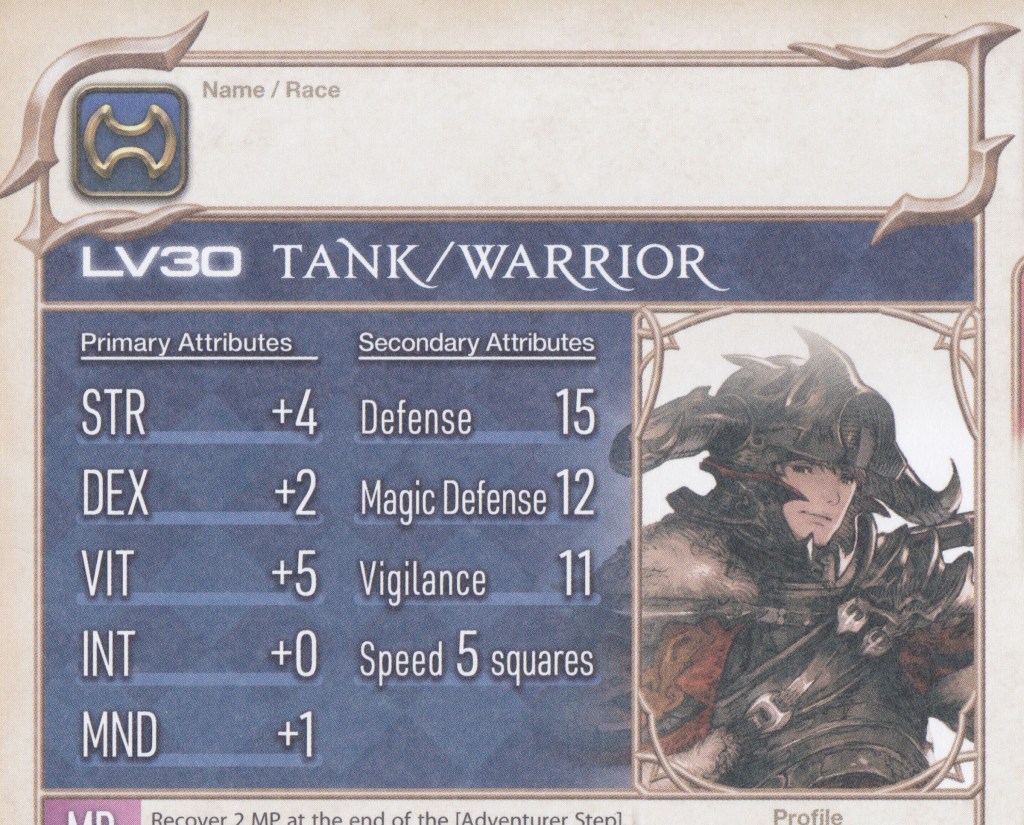
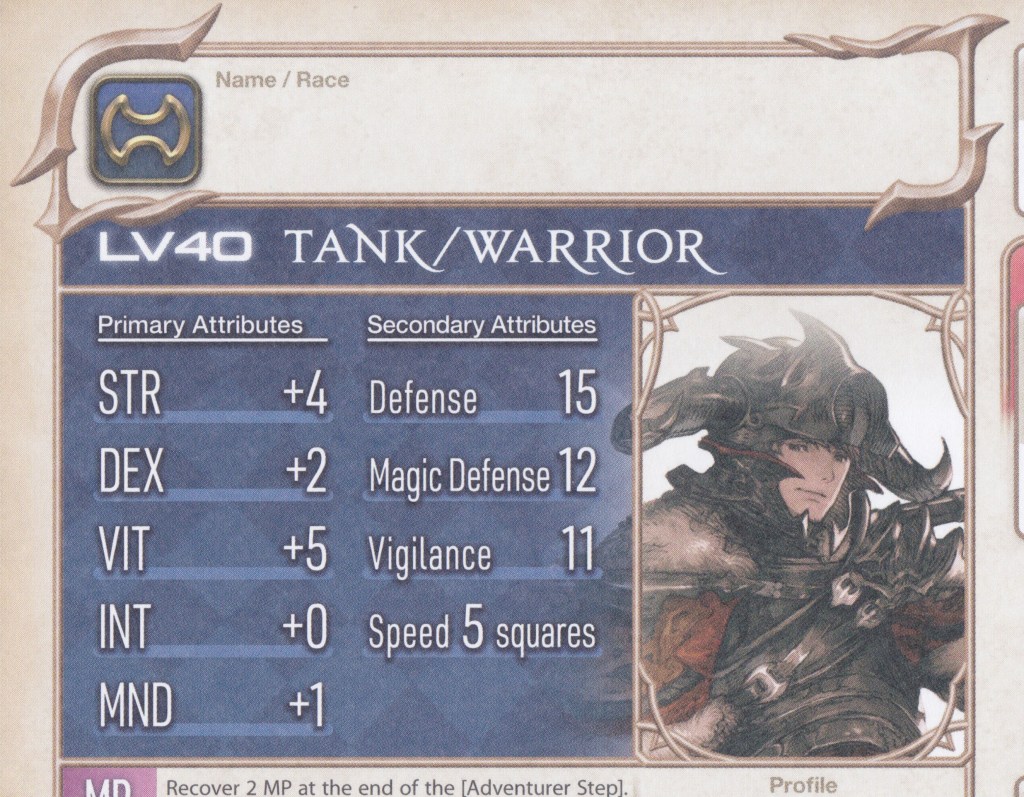
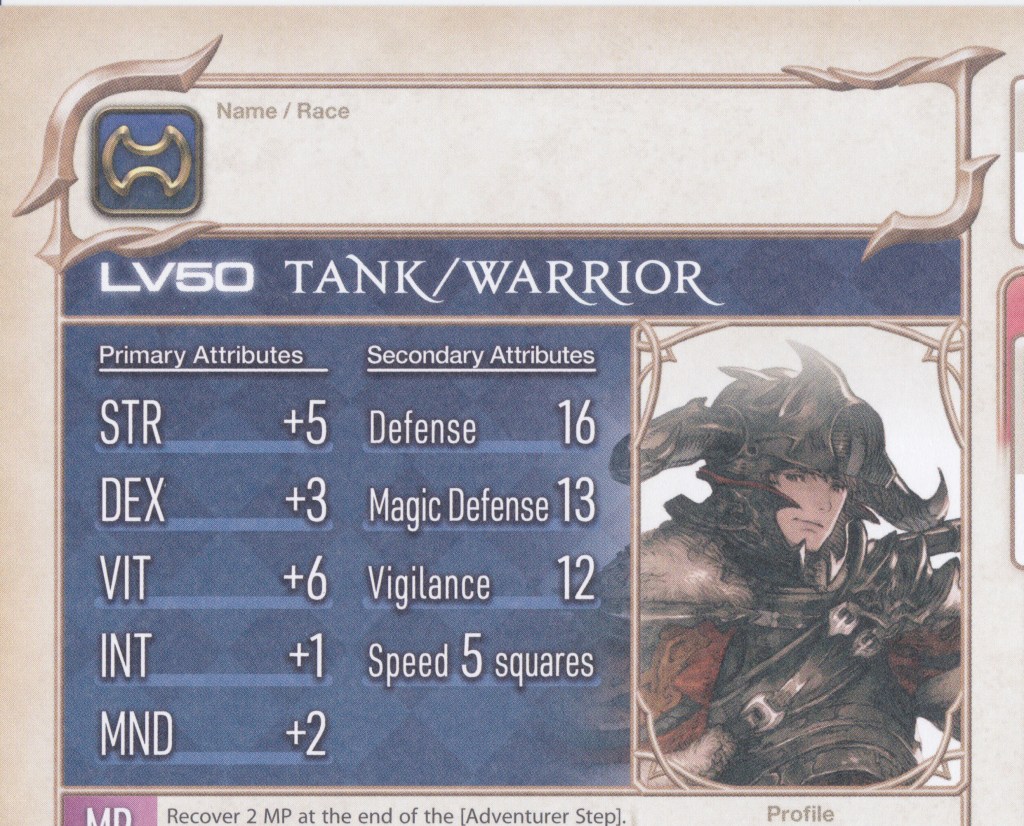
Not knowing how finely graded the leveling is in FF XIV TTRPG, it’s hard to say whether there are ‘dead levels’ or not. To a D&D mindset, a difference of ten levels is paradigm-shifting, whereas in FF XIV, it looks as if they are much more tightly constrained. I am inclined to think that the TTRPG levels up in increments of ten.
As far as the warrior’s attributes are concerned, there is no difference between the level 30 warrior and the level 40 warrior; they are identical in this regard.
At level 50,all of the warrior’s primary and secondary attributes are increased aside from the warrior’s speed.
As the game allows level sync; ie, allowing adventurers of mixed levels to adventure together – I am guessing that it’s in the warrior’s abilities where we will see the real differences between level 30 and level 40. I can also see how the tight constraint between level 30 and 40 can be very beneficial to level sync as you won’t have one character outshining the rest of the party as you would in an f20 game.
Outside of combat, I can definitely see the level 50 warrior making fewer rolls outside of combat – the challenge would have to be extraordinary to warrant an ability check unless it’s to measure a degree of success. At +5 to STR, the average result for a level 50 warrior is going to be 16.5. So unless the challenge difficulty is Very Hard (CR 20) or higher, there is little reason to have the warrior’s player rolling for STR unless you have a direct consequence already planned for failing that check. Given the fact that the Gamemaster Book states FFXIV is not a play to find out RPG, the GM would need to already have in mind the consequences for such a roll.
To dig a little further into this, the example in the Player Book has the adventurers come across a toppled chocobo cart. Righting the cart has a CR of 13. Unless the GM already has direct consequences in mind for this obstacle, the level 50 warrior should be able to simply right the cart without requiring a roll.
Another interesting aspect of the level 50 warrior is the fact that all of the attributes aside from speed increase by 5%, unlike in most f20 games where the player selects a single attribute to increase every few levels.
MP, HP, AND ITEMS
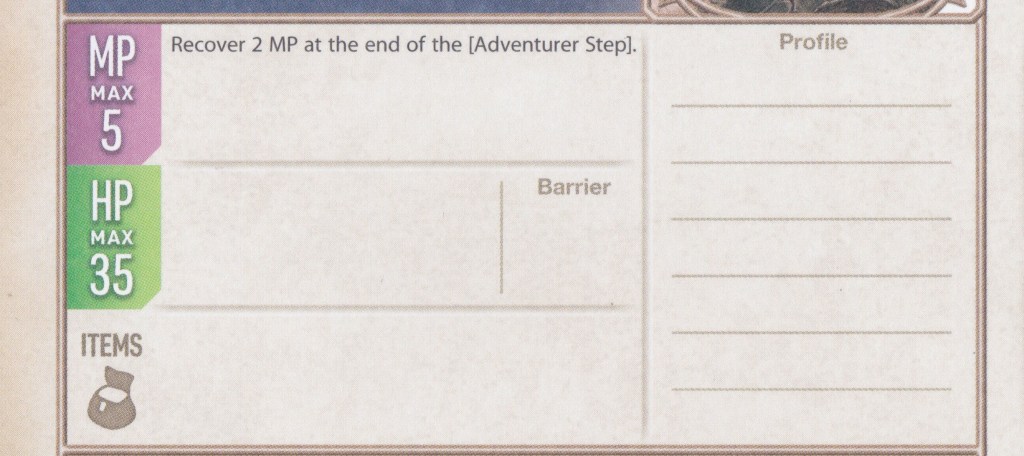


MP appears to be the most valuable resource in the game, with it capped at 5. Being able to recover 2MP per round looks like a great way to keep things strategically interesting.
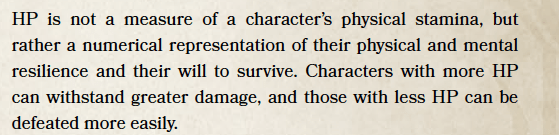
Unlike MP, HP appears to be a purely arbitrary number. It is not tied to any particular attribute score, as mentioned in the Player Book.

So, is 35 HP a lot? Is 63 a lot? Without playing through any encounters I cannot say, but this is something we will be comparing across the various roles. It’s probably safe to assume that the tank will have much higher HP than the other roles in the game, however.
I do love how FFXIV treats HP, not as your ‘life force’ or somehow tied to your skill in combat, but more like a breaking mechanic; when it reaches 0, your character’s morale breaks and they ‘die’; ie, they are removed from the encounter unless you have a means of raising them or invoke quicksave.
To avoid constantly crossing out or erasing and re-writing MP, I would probably assign specific colored tokens to keep track of MP, with a central pool that the players can draw from to replace MP markers. Since there’s a hard cap, you simply need [number of players] x 5 tokens in total.
TRAITS & OTHER EFFECTS
Traits and effects are related to a particular job’s abilities. Abilities are classified as Primary, Secondary, and Instant. Each character has a finite amount of each type of ability they can use each round.
There are 2 effects/traits which are common across all 3 warrior pregens: Combo and Enmity. This forms the backbone of the the warrior job. Let’s look at each one of these in depth.

A Combo grants a character an additional ability they can use at any point during their turn. Since movement in FFXIV can be broken up however you see fit, a character can move, actrivate an ability with the Combo effect, move again, and then use the Combo on a different target than the one in which the ability was used to ‘charge up’ the Combo.

As we can see above, Storm’s Path not only deals 2 damage as its base effect, but it also restores 2 HP to the warrior. Note that both Heavy Swing and Storm’s Path inflict Enmity on the warrior’s target. As you cannot stack the same Enfeeblement twice on a single target, the warrior player may be better served inflicting multiple targets.
Enmity is a devastating Enfeeblement which inflicts a -5 penalty to all ability checks and lasts until the end of the target’s next turn. Brutal!
PRIMARY ABILITIES
It is worth noting that all of the warrior’s Primary abilities inflict Enmity on their target.
It doesn’t take a genius to see that FFXIV replicates, almost precisely, the rotations you find in the MMO, even down to the icons next to each ability.
The other non-combo Primary abilities at the warrior’s disposal cover a wider AoE or have a range associated with them. Handy for when the warrior is surrounded, out of range, or has used up his movement for the round. Being able to drop yourself in the middle of a horde of enemies and inflict Enmity on all of them is super badass!
SECONDARY ABILITIES
Although they are called Secondary abilities, they can be performed before a Primary ability. In fact, the Beserk Secondary ability should be activated before your Primary because it increases damage output until the end of the turn, as should Rampart, which reduces damage taken. Being able to tune how your particular character behaves (are you leaning more towards the warrior side/ damage output or the tank side/ damage reduction?) adds a significant amount of strategic depth to the warrior.
INSTANT ABILITIES
Instant abilities are a little difficult to grasp at first as the rules do not do a great job at explaining them, and the character sheet is also a little confusing in this regard. Let’s break it down a bit to unlock the Instant ability’s secrets.
The confusion stems from the rather awkward phrasing of a character not being able to “use multiple instant abilities on a given turn”. This goes into the core of what FF XIV considers a “turn”.
It’s probably more helpful to think of Instant abilities in relation to the round, not turns. Most Instant abilities have a use limitation of once per phase, which I feel is the key wording here, not the confusingly stated “on a given turn”.
This also demonstrates the degree of tactical depth on display in FF XIV. For example, given the wording, you may conclude that Instant abilities can only be triggered during the Enemy phase of a round. Careful reading, however, indicates that come Instant abilities can be used as a reaction to enemy Instant abilities!
For example, the Instant ability Reprisal reads:
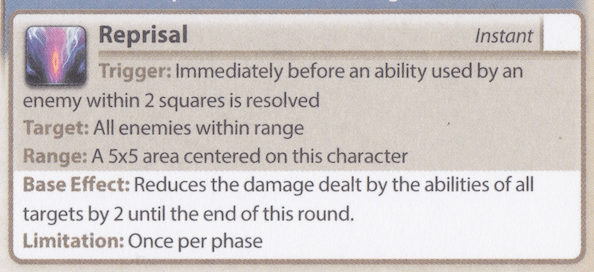
Reprisal does not stipulate a specific phase, so an alert player could use Reprisal during another player’s turn in the Adventurer phase in reaction to an enemy’s Instant ability. Further, if you are especially alert, you will note that you can use this Instant ability up to two times per round, as it’s limitation is “once per phase”, and there are two phases in every round.
ADDITIONAL EFFECTS
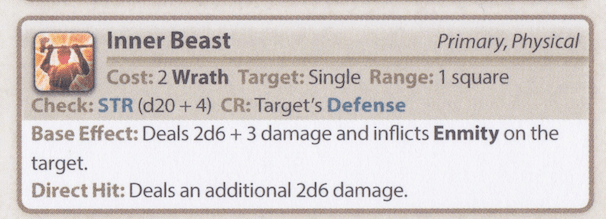
Wrath is an additional resource that the warrior gains at Level 40, adding even further tactical depth. Wrath unlocks a very powerful Primary ability, Inner Beast.
LIMIT BREAK
But wait, there’s more! A Limit Break is a special ability that is put in effect at the top of a round either by GM’s discretion or as stipulated by a scenario. For example, the GM may state that a Limit Break can be used when a character reaches 50% and 25% of their HP.
The warrior’s Limit Break is Land Walker. If timed well, not only does this limit the damage taken by the warrior, but it also damages the enemy that triggered it, causing it to reflect back upon them.
CONCLUSIONS
I absolutely love how the warrior’s abilities all lean into the concept of a true tank build — you are rewarded for being in the thick of things or holding a defensive position.
Everything about the warrior is super evocative and inspiring. The number of combinations of various abilities in conjunction with the other characters and enemies, terrain, and special circumstances make even this starter set character worthy of multiple replays before you will begin to exhaust all of the possible permutations.

 Math & Myth
Leave a comment